
Your Mission Drift Prevention Toolkit (Or: How to Say No to the Wrong Money)

Right. Last week I told you about Emma and Haven House, and how saying no to £200,000 turned out to be the smartest decision they ever made.

Now comes the tricky bit: how do you actually make that call when the money’s sitting there and your budget’s looking thin?

Because it’s easy to read a nice story and think “yes, that makes sense.” It’s much harder when you’re staring at a funding opportunity that could solve your financial problems, even if it doesn’t quite fit what you do.

So let’s build you a toolkit. Not a complicated strategic framework that needs a consultant to interpret—just some honest questions that’ll help you spot mission drift before it derails you.

Continue reading
Measuring What Matters: Impact Frameworks for Small Community Organisations

Estimated read time: 6 minutes

Right, let’s talk about something that makes most charity volunteers groan: measuring impact

You know the drill. You’re running a brilliant community group, changing lives left and right, and then someone with a clipboard rocks up asking, “So… how many people did you help exactly?”

It’s a fair question, honestly. But really, it’s not the only one that matters, is it?

Take Sarah from Oakdale Community Sports Hub (Sarah and her charity are fictional, but their story mirrors what happens to real organisations across the UK every day). Last year, her team ran 300 sessions and got over 500 people through the doors. Impressive numbers, right? Tick, tick, tick on the funding application.

But here’s what those numbers don’t tell you: There’s young Jamie who used to hide behind his mum’s legs and now captains the under-10s. There’s Frank, 73, desperately lonely since his wife died last spring—without the club, he’d be isolated, depressed, and struggling with thoughts of ending it all. These Tuesday sessions aren’t just exercise for Frank; they’re a lifeline.

Those are the stories that actually matter. But try putting “restored hope in widowed grandfather” on a spreadsheet and see how far you get.

So how do we capture the stuff that really counts without drowning in paperwork? Let’s figure it out.

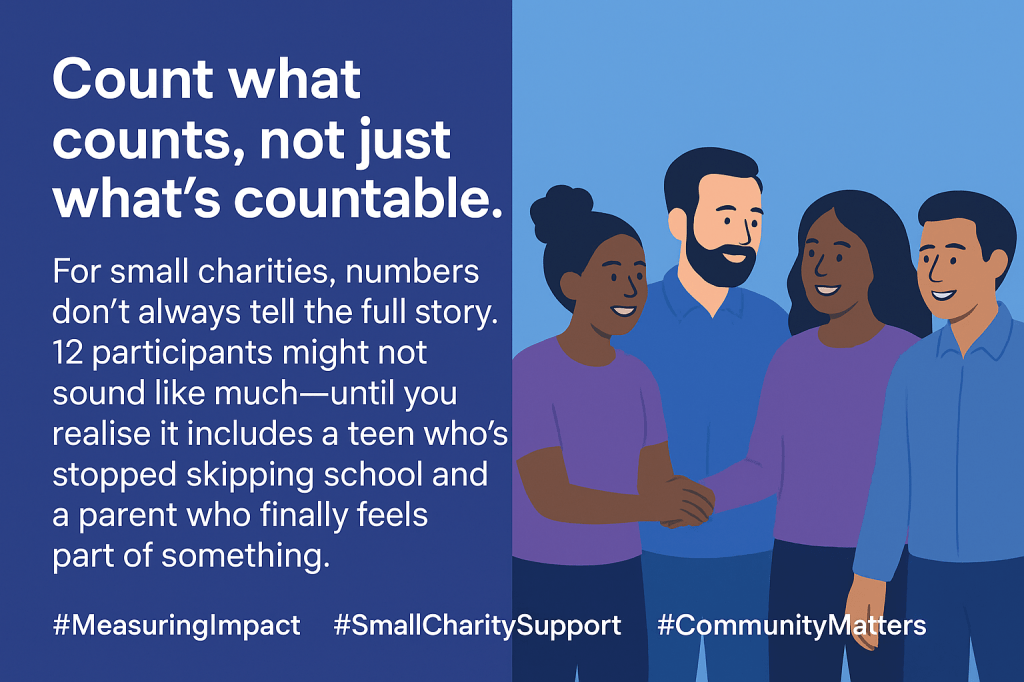
“Count what counts, not just what’s countable.”
For small charities, numbers don’t always tell the full story. 12 participants might not sound like much—until you realise it includes a teen who’s stopped skipping school and a parent who finally feels part of something.
We’ve written a practical guide on how to capture the impact that really matters.
Continue reading

The Burnout Warning Signs: Protecting Trustees

Read time: 8 minutes

Sarah sounds tired when she calls. Really tired. Not the kind of tired that comes from a busy day teaching primary school children, but something deeper. Something that sleep doesn’t seem to fix.

Three years ago, Sarah joined the board of Oakdale Community Sports Hub with excitement. She’d been volunteering as a football coach and wanted to help the charity grow. Now, when she talks about the Hub, there’s still love in her voice—but it’s mixed with something else. Worry. Exhaustion. The weight of feeling responsible for keeping the doors open.

Sarah and her charity are fictional, but their story mirrors what happens to real organisations across the UK every day.

Continue reading

When to Walk Away: Declining Misaligned Funding

Read time: 10 minutes

The £50,000 Decision That Nearly Broke Everything

Sarah and her charity are fictional, but their story mirrors what happens to real organisations across the UK every day.

When Sarah first saw the email offering £50,000 to her small community sports charity, she genuinely thought she’d won the lottery. Her organisation had been running youth football programmes in Manchester for three years on practically nothing—mostly small donations and brilliant volunteer coaches who believed in what they were doing. That funding would sort their immediate money worries and let them reach more young people.

Six months later, Sarah found herself sitting in a draughty community centre, fighting back tears as she tried to explain to her trustees how that ‘lifeline’ funding had nearly destroyed everything they’d built.

The grant had come with strings she hadn’t spotted in the excitement: reporting systems that ate up 15 hours every week, programme changes that completely put off their core community, and targets that forced them to chase numbers instead of nurturing the genuine relationships that actually made their work brilliant. By month four, two of her best volunteer coaches had walked away in frustration, and the young people they served were drifting off to hang about street corners again.

Sarah’s story plays out across Britain’s charity sector more often than we’d like to admit. Organisations everywhere are learning a tough lesson: not all funding is good funding.

And that’s a conversation we need to have.

Continue reading

Can You Pass the 15-Second Test?

It’s a simple test – but not an easy one.

Being able to explain your charity’s purpose in 15 seconds is a huge asset. Not just for funding bids, but for networking, staff induction, and even trustee recruitment.

Ask your team: could we all give the same answer? Would it be clear and memorable?

If not, try writing a few versions together. It doesn’t have to sound clever. It just needs to be honest.

#CharityLeadership #MissionStatement #FundraisingTips #NonprofitClarity