💥 Get Ready for the Catastrophe: The Art of Stupidity’s 40-Week Charity Fails Masterclass

The Stupid is Coming…

Right, listen up.

I’ve spent too much time watching well-meaning charities make world-class, utterly avoidable, administrative disasters.

We’re talking about the simple, everyday failures that put your funding at risk, land your trustees in legal hot water, and make the whole sector look like it’s being run by people who found their job description in a Christmas cracker.

I’m calling time on pretending everything is fine.

Continue reading

🤦When Good Intentions Go Massively Tits-Up

Right, settle in. We’ve all been there, haven’t we? That moment you try to be incredibly helpful and, instead, you look like a prize pilchard. I’m talking about my latest spectacular self-sabotage, an act of sheer, well-meaning idiocy involving one of my brilliant clients.

My Helpful Default Mode

For those who don’t know, my two birth-children are technically adults now. They are both brilliantly capable, but they still manage to drive me insane and do spectacularly stupid things. They are also severely dyslexic. I’ve lived the struggle, and I know that sometimes, a great, big wall of text is the absolute worst. A quick voice note? Brilliant. A chat? Even better. It’s my default setting for communicating anything important to them.

Continue reading

Skills-Based Trustee Recruitment: Build Your Dream Team

Estimated read time: 9–10 minutes

When good intentions meet governance reality

Sarah joined the board of Oakdale Community Sports Hub after years of volunteering on the football pitch. She’s practical, community-minded, and one of those people who just get things done. But after their last trustee meeting, she sat in her car for ten minutes with a proper knot in her stomach.

(Sarah and her charity are fictional, but their story mirrors what happens to real organisations across the UK every day.)

Continue reading

Beyond the Cliff-Edge: Practical Steps for Long-Term Funding in Small Charities

Read time: 8 minutes

Last month, Sarah opened an email that started with: “We regret to inform you…” Another grant rejection. That was supposed to cover coaching costs for the next year. Without it, Oakdale Community Sports Hub had to dip into reserves—again. They’ve got three months’ breathing space, maybe four, before the treasurer starts sounding the alarm.

To make matters harder, their Sport England funding had just ended. They knew the rules: no chance of reapplying until the project was fully wrapped up. And even then, they’d be waiting months before hearing back. Best case, if they applied the day after their grant ended, it could still be five months before new funding landed in the bank. That left Oakdale staring at a gap of half a year or more with no guarantee of support.

Sarah and her charity are fictional, but their story mirrors what happens to real organisations across the UK every day.

If you’re involved with a grassroots group, chances are you’ve felt that same mix of relief when a grant comes in and dread when the next one’s uncertain.

If you’ve ever sat round a committee table with the bank balance dropping and volunteers looking worn out, you’ll know exactly how Sarah and her team felt. This isn’t bad management; it’s the reality of grant-reliant funding. The cliff-edge happens to the best of us. The question is: how do you build a bit more stability into the picture?

Let’s look at some practical, achievable steps that even a small volunteer-led committee can put into action.

Continue reading

Measuring What Matters: Impact Frameworks for Small Community Organisations

Estimated read time: 6 minutes

Right, let’s talk about something that makes most charity volunteers groan: measuring impact

You know the drill. You’re running a brilliant community group, changing lives left and right, and then someone with a clipboard rocks up asking, “So… how many people did you help exactly?”

It’s a fair question, honestly. But really, it’s not the only one that matters, is it?

Take Sarah from Oakdale Community Sports Hub (Sarah and her charity are fictional, but their story mirrors what happens to real organisations across the UK every day). Last year, her team ran 300 sessions and got over 500 people through the doors. Impressive numbers, right? Tick, tick, tick on the funding application.

But here’s what those numbers don’t tell you: There’s young Jamie who used to hide behind his mum’s legs and now captains the under-10s. There’s Frank, 73, desperately lonely since his wife died last spring—without the club, he’d be isolated, depressed, and struggling with thoughts of ending it all. These Tuesday sessions aren’t just exercise for Frank; they’re a lifeline.

Those are the stories that actually matter. But try putting “restored hope in widowed grandfather” on a spreadsheet and see how far you get.

So how do we capture the stuff that really counts without drowning in paperwork? Let’s figure it out.

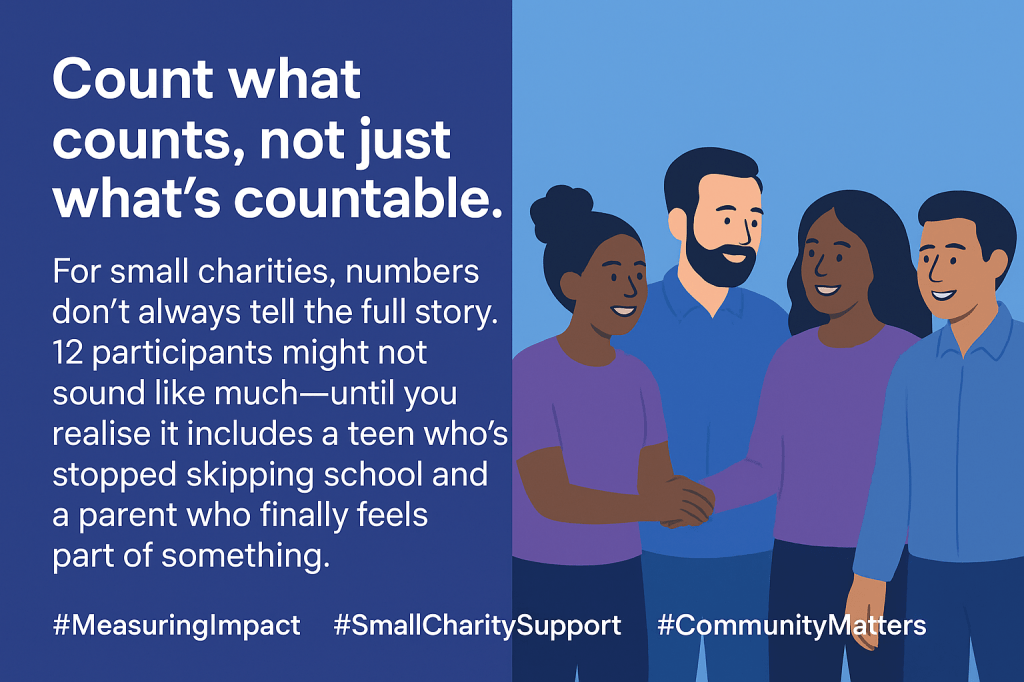
“Count what counts, not just what’s countable.”
For small charities, numbers don’t always tell the full story. 12 participants might not sound like much—until you realise it includes a teen who’s stopped skipping school and a parent who finally feels part of something.
We’ve written a practical guide on how to capture the impact that really matters.
Continue reading

The Burnout Warning Signs: Protecting Trustees

Read time: 8 minutes

Sarah sounds tired when she calls. Really tired. Not the kind of tired that comes from a busy day teaching primary school children, but something deeper. Something that sleep doesn’t seem to fix.

Three years ago, Sarah joined the board of Oakdale Community Sports Hub with excitement. She’d been volunteering as a football coach and wanted to help the charity grow. Now, when she talks about the Hub, there’s still love in her voice—but it’s mixed with something else. Worry. Exhaustion. The weight of feeling responsible for keeping the doors open.

Sarah and her charity are fictional, but their story mirrors what happens to real organisations across the UK every day.

Continue reading

When to Walk Away: Declining Misaligned Funding

Read time: 10 minutes

The £50,000 Decision That Nearly Broke Everything

Sarah and her charity are fictional, but their story mirrors what happens to real organisations across the UK every day.

When Sarah first saw the email offering £50,000 to her small community sports charity, she genuinely thought she’d won the lottery. Her organisation had been running youth football programmes in Manchester for three years on practically nothing—mostly small donations and brilliant volunteer coaches who believed in what they were doing. That funding would sort their immediate money worries and let them reach more young people.

Six months later, Sarah found herself sitting in a draughty community centre, fighting back tears as she tried to explain to her trustees how that ‘lifeline’ funding had nearly destroyed everything they’d built.

The grant had come with strings she hadn’t spotted in the excitement: reporting systems that ate up 15 hours every week, programme changes that completely put off their core community, and targets that forced them to chase numbers instead of nurturing the genuine relationships that actually made their work brilliant. By month four, two of her best volunteer coaches had walked away in frustration, and the young people they served were drifting off to hang about street corners again.

Sarah’s story plays out across Britain’s charity sector more often than we’d like to admit. Organisations everywhere are learning a tough lesson: not all funding is good funding.

And that’s a conversation we need to have.

Continue reading

Can You Pass the 15-Second Test?

It’s a simple test – but not an easy one.

Being able to explain your charity’s purpose in 15 seconds is a huge asset. Not just for funding bids, but for networking, staff induction, and even trustee recruitment.

Ask your team: could we all give the same answer? Would it be clear and memorable?

If not, try writing a few versions together. It doesn’t have to sound clever. It just needs to be honest.

#CharityLeadership #MissionStatement #FundraisingTips #NonprofitClarity

Grant Readiness Checklist: Is Your Small Charity Prepared?

Read time: 6 minutes

Your charity does brilliant work. But when that perfect grant opportunity lands in your inbox, can you respond with confidence? Research shows 82% of successful applicants prepare their core documents well in advance—and there’s good reason for that.

Grant readiness isn’t about having a crystal ball. It’s about having the right foundations in place so you can move quickly when opportunities arise. And crucially, it’s about having all this information organised and accessible—whether that’s a physical folder system or a digital solution.

Consider using a tool like Evernote, Notion, Google Drive, or OneDrive. Personally, I use Evernote because its AI search function means I can find anything quickly—even when I’ve inevitably misfiled something. The key is having everything searchable and accessible from anywhere.

What’s brilliant about these platforms is that they’re all shareable across your organisation. You can give your whole team access to work collaboratively on documents, or set permissions so only certain people can edit while others can view. No more emailing documents back and forth or wondering who has the latest version.

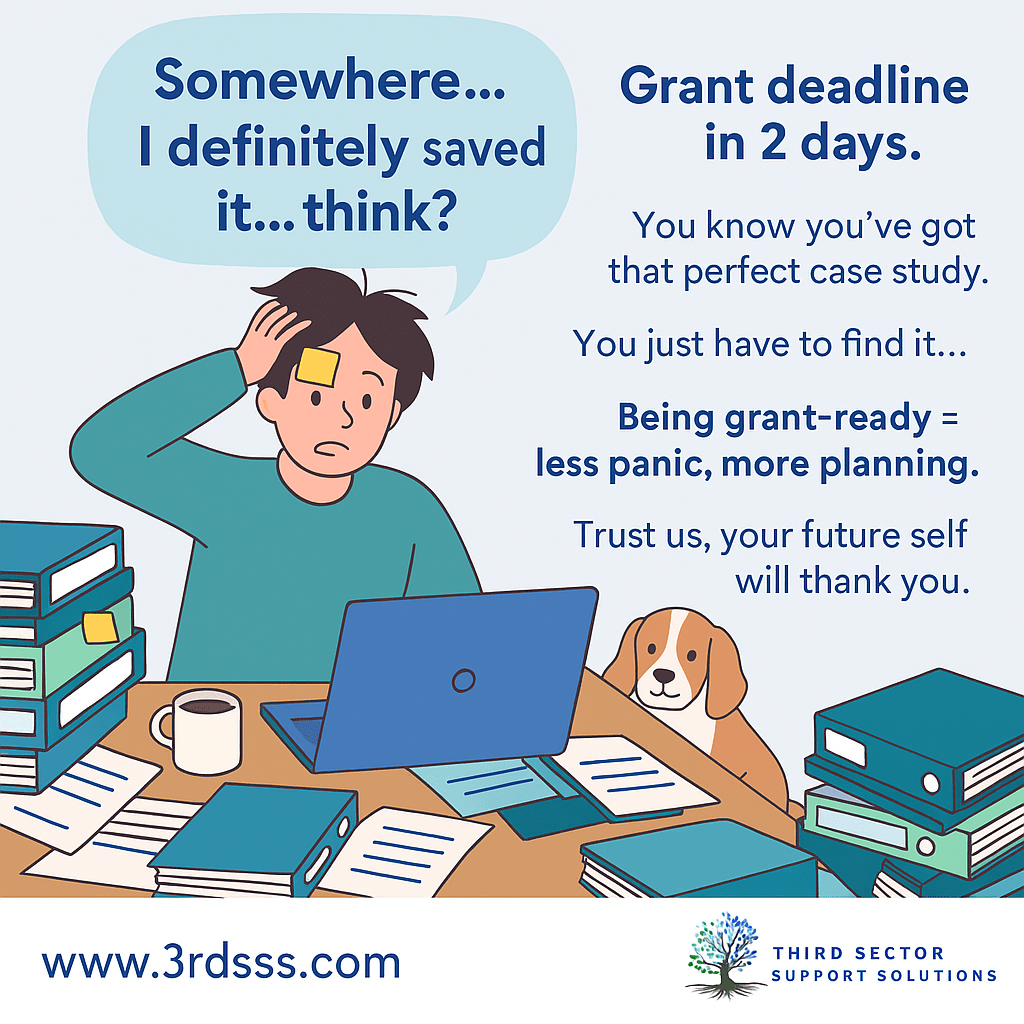
There’s nothing worse than knowing you have that perfect case study somewhere but spending an hour hunting for it while a deadline looms. We’re all human—things get misfiled. But good systems with search functionality can be a lifesaver.

Here’s your practical checklist to get there.

Continue reading

Welcome to Third Sector Support Solutions: Where Every Organisation Matters

Read time: approximately 8 minutes

Things Are Tough at the Best of Times—We’re Here to Make It Easier for You, Not Harder

Hello there. I’m Constance Grayson, and I’m really glad you’ve found your way here.

After working in the UK’s charity and community sector for over 20 years, I’ve noticed something wonderful: some of the most powerful changes happen in the most ordinary places. Around kitchen tables where neighbours decide enough is enough. In community centres where someone puts up a hand and says “I’ll help with that.” In conversations between people who simply refuse to accept that things can’t get better.

I’ve also noticed that these everyday heroes often face exactly the same hurdles as the big charities when it comes to getting funding—but without the resources, jargon dictionaries, or dedicated teams to help them navigate it all.

That’s why Third Sector Support Solutions exists. We believe that good ideas, genuine commitment, and real community need should be able to access the resources they deserve—whether your paperwork comes on fancy letterhead or you’re still figuring out what a “case for support” actually means.

Continue reading