
Right. Last week I told you about Emma and Haven House, and how saying no to £200,000 turned out to be the smartest decision they ever made.
Now comes the tricky bit: how do you actually make that call when the money’s sitting there and your budget’s looking thin?
Because it’s easy to read a nice story and think “yes, that makes sense.” It’s much harder when you’re staring at a funding opportunity that could solve your financial problems, even if it doesn’t quite fit what you do.
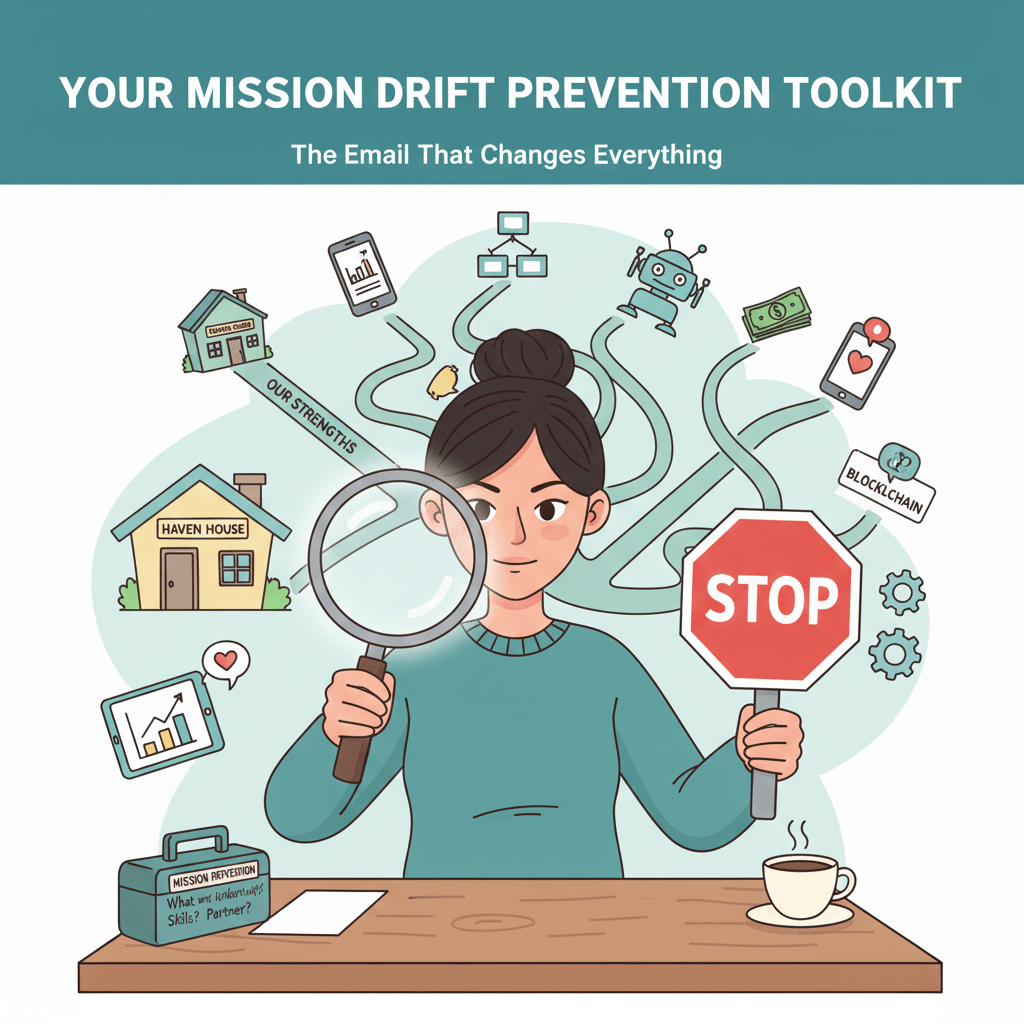
So let’s build you a toolkit. Not a complicated strategic framework that needs a consultant to interpret—just some honest questions that’ll help you spot mission drift before it derails you.
The Questions That Actually Matter
Before you even start writing that application, grab a coffee and work through these. (And yes, I mean actually work through them. Not just skim and think “yeah, yeah, I get it.”)
What Are We Actually Brilliant At?
Be specific here. “Helping people” isn’t an answer. “Providing face-to-face support to help homeless people navigate the housing benefits system” is an answer.
Ask yourself:
- What do other organisations send people to us for?
- What would our clients miss most if we stopped doing it?
- What expertise have we spent years developing that would be genuinely hard to replace?
- When people describe our organisation, what’s the first thing they mention?
Write this down. Properly. Because when that funding opportunity is dangling in front of you, you’ll need to remember what you’re actually good at.
Does This Money Help Us Do That Thing Better?
This is the big one.
Will this funding help you do your core work better, faster, or for more people? Or does it want you to do something completely different?
A homelessness charity getting funding to expand their emergency accommodation? That’s building on their strengths.
That same homelessness charity getting funding to develop an AI app? That’s a whole new thing that has nothing to do with what they’re good at.
If less than 70% of the funded work involves things you’re already competent at, alarm bells should be ringing.
The Skills Question
If this funding requires new skills, ask yourself: will those skills serve our mission beyond this specific grant?
Learning how to do better social media so you can tell your story and raise unrestricted funds? Yes, that’s useful long-term.
Learning blockchain technology because it’s in the funding criteria? Unless you’re planning to become a blockchain charity (please don’t), that’s a dead end.
Could Someone Else Do This Better?
Here’s a question that requires real honesty: if this funding wants work that isn’t your core strength, could you partner with an organisation who’s brilliant at that bit?
Often the strongest work happens when organisations stick to what they’re good at and collaborate, rather than one charity trying to do everything badly.
And look, I know partnership bids can be complicated. But they’re usually less complicated than trying to deliver work you’re not equipped for.
Red Flags That Should Make You Run
Some funding opportunities are mission drift dressed up in nice language. Here’s how to spot them:
The Jargon Test: If you can’t explain the funding opportunity to your clients in plain English, it’s probably not for you. Seriously—if you find yourself talking about “innovative digital ecosystems for enhanced stakeholder engagement,” stop. Your clients don’t talk like that. If the work was right for you, you’d be able to explain it in normal words.
The Expertise Gap: If delivering this project would require hiring entirely new staff with completely different skills, question whether it’s really your project to do. You’re a charity, not a recruitment agency.
The Budget Takeover: If this funding would become such a large part of your budget that losing it would threaten your survival, think very carefully about the strings attached. That’s not funding—that’s dependency.
The Scope Creep: Watch out for projects that keep expanding during the application process. If it started as “supporting 20 families” and now involves “developing a digital platform, creating training resources, and establishing a national network,” you’re heading into mission drift territory.
What Happens After the Funding Ends?
This is the question people forget to ask.
When this three-year grant finishes, will you be better equipped to do your core work? Or will you be stuck trying to find more funding for activities that were never really your thing in the first place?
Emma at Haven House asked this question. If they’d taken that digital funding, they’d have spent three years building tech skills they didn’t need, and then faced a choice: abandon the digital work (wasting three years) or keep chasing digital funding forever (mission drift achieved).
Instead, they spent those years getting even better at what they were already brilliant at. Now they’re the go-to organisation for face-to-face homelessness support in their area.
Building Your Own Criteria
Every charity is different. You need to develop your own specific criteria based on what makes you special.
Here’s how to do it:
Sit down with your team (and yes, this includes your trustees, not just staff) and honestly assess: what are we genuinely excellent at? What do we do that would be difficult for another organisation to replicate?
Identify where you could grow whilst building on existing strengths. Where’s the natural next step? What adjacent work uses similar skills? What would make your existing work more effective?
Set your non-negotiables. What would you never compromise, regardless of funding available? Which values are absolutely central to who you are? What work are you not willing to stop doing, even if someone offered you serious money to pivot?
Write all this down. Make it a simple one-page document. Then, when a funding opportunity appears, you can test it against your criteria before you spend hours on an application.
The Confidence to Be Specific
Here’s what I’ve noticed: the organisations that try to do everything usually end up being mediocre at most things.
And in a sector where trust is everything, mediocre doesn’t cut it.
Your clients don’t need you to chase every trend. They need you to be brilliant at the specific thing that helps them.
Funders don’t need you to use all the latest buzzwords. They need you to demonstrate genuine expertise and measurable impact in your area of focus.
Partners don’t need you to duplicate their work. They need you to do your thing brilliantly so they can do their thing brilliantly, and together you create something neither could achieve alone.
What Happens When You Stay Focused
Look, Emma and Haven House are fictional – I made them up to illustrate a point. But the pattern they represent? That’s real, and I see it playing out all the time.
When organisations have the guts to stay focused on what they’re actually good at, a few things tend to happen:
Their reputation for their core work gets stronger. Word spreads. People start seeking them out specifically because they’re known for doing that one thing brilliantly.
Their team gets better at what they do. When you’re not constantly pivoting to chase the latest trend, you can invest in actually deepening your expertise. Your staff become specialists, not generalists scrambling to keep up.
Their clients get more consistent, higher-quality support. Deep expertise matters. The charity that’s been doing face-to-face homelessness support for a decade will always do it better than the one that started last year because the funding was available.
And yes, the right funding does tend to find them. When funders are looking for genuine expertise in a specific area, they seek out organisations with a track record. You become the obvious choice, not just another applicant.
Being known for something specific turns out to be quite powerful.
Your Competitive Advantage Is Your Focus
We work in an increasingly crowded charity sector. Everyone’s fighting for the same funding pots. Everyone’s trying to stand out.
And what do most organisations do? They try to do everything. They add services. They chase trends. They become generalists.
But here’s the thing: your competitive advantage isn’t trying to do everything. It’s being irreplaceably good at something specific.
The right funding will strengthen what you’re already brilliant at.
The wrong funding will distract you from what makes you irreplaceable.
The Question That Cuts Through Everything
Next time you’re looking at a funding opportunity and you’re not sure if it’s right, ask yourself this:
If we do this work, will the people we serve say “yes, that’s exactly what we needed from you” or “that’s a bit random, isn’t it?”
If it’s the second one, you’ve got your answer.
Your mission matters too much to dilute with every passing trend. Fund your strengths, build your expertise, and trust that excellence in a focused area creates more impact than spreading yourself too thin.
The people you serve, the partners you work with, and the funders who truly understand your work will thank you for having the courage to stay focused on what you do best.
Even if it means saying no to £200,000.
Have you ever turned down funding because it wasn’t right for your organisation? Or taken funding you regretted? I’d genuinely love to hear your stories—the real, messy ones. Drop them in the comments or email me. Because Emma’s fictional, but your experiences aren’t, and we learn more from each other’s honest stories than from perfect case studies.
 The Art of Stupidity