
Estimated read time: 6 minutes
Right, let’s talk about something that makes most charity volunteers groan: measuring impact
You know the drill. You’re running a brilliant community group, changing lives left and right, and then someone with a clipboard rocks up asking, “So… how many people did you help exactly?”
It’s a fair question, honestly. But really, it’s not the only one that matters, is it?
Take Sarah from Oakdale Community Sports Hub (Sarah and her charity are fictional, but their story mirrors what happens to real organisations across the UK every day). Last year, her team ran 300 sessions and got over 500 people through the doors. Impressive numbers, right? Tick, tick, tick on the funding application.
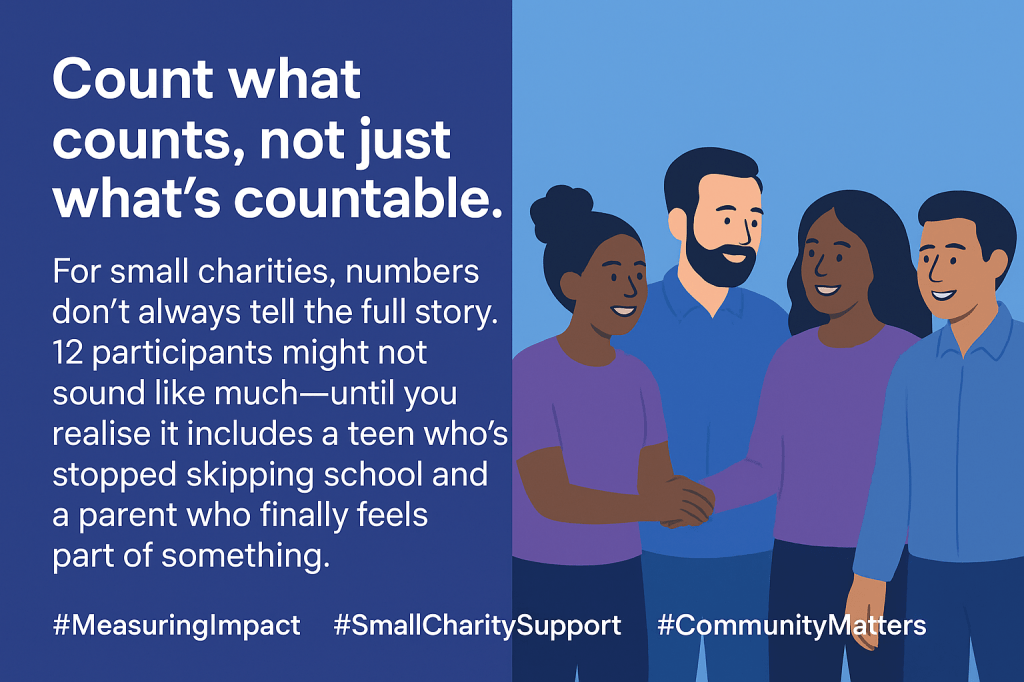
But here’s what those numbers don’t tell you: There’s young Jamie who used to hide behind his mum’s legs and now captains the under-10s. There’s Frank, 73, desperately lonely since his wife died last spring—without the club, he’d be isolated, depressed, and struggling with thoughts of ending it all. These Tuesday sessions aren’t just exercise for Frank; they’re a lifeline.
Those are the stories that actually matter. But try putting “restored hope in widowed grandfather” on a spreadsheet and see how far you get.
So how do we capture the stuff that really counts without drowning in paperwork? Let’s figure it out.
Start with what genuinely matters (not what sounds impressive)
Before you even think about surveys or data collection, take time to have a strategic conversation with your team. Ask yourselves: What does meaningful change look like in our community?
For Sarah’s lot, it wasn’t just about getting people off the sofa. It was about confidence, connection, and creating somewhere people actually want to be. So they started tracking things that reflected that:
- How many kids kept coming back week after week?
- How many adults said they felt less lonely?
- How many parents noticed their child sleeping better or making friends?
Your metrics should tell your story, not pad out someone else’s report.
The funder relationship (and how to navigate it successfully)
Here’s where it gets more nuanced. Funders often require standardised data—attendance figures, demographic breakdowns, postcode analysis. This information has value, but it doesn’t capture the full picture of your work.
This doesn’t need to be a compromise on your values. Sarah developed an approach that served both needs effectively: providing funders with the quantitative data they required while supporting it with compelling qualitative evidence. An 85% retention rate paired with a parent’s testimonial: “He’s like a different child—confident, happy, chatting our ears off about football.”
You don’t need to bend your mission out of shape. You just need to translate your impact into language that makes sense to people who speak in percentages and outcomes.
A dead simple five-step framework (no consultants required)
Forget the fancy reports and complicated theories. Here’s how to build an impact framework that actually works:
Step 1: Remember why you started What change are you trying to make? Write it down in plain English.
Step 2: List what you actually do Map out your day-to-day activities. Be honest—including the tea-making and the tidying up.
Step 3: Connect the dots What happens because of what you do? Think short-term (kids turn up regularly) and long-term (families feel more connected to their community).
Step 4: Pick your key indicators Choose 3-5 simple things you can track. If it takes more than five minutes to explain, it’s too complicated.
Step 5: Check in regularly What’s working? What’s changed? What can you bin? Be ruthless—if you’re not using the data, stop collecting it.
This keeps things manageable and gives you proper evidence for funding bids, trustee reports, and those awkward conversations with the council.
Don’t make these classic mistakes
Trying to measure everything: You’ll burn out faster than a sparkler in November. Focus on what actually matters.
Getting too clever with language: If you can’t explain your impact to your nan, it’s too complicated.
Collecting data for the sake of it: If it’s not helping you learn or tell your story better, bin it.
Chasing every funding buzzword: Stick to your guns. Adapt your language, don’t twist your mission.
Trustee Workshop Tool: Get your board involved in shaping impact
Want to get your trustees genuinely engaged in defining what impact means for your organisation? Try this proven approach:
🗣 Impact Mapping Discussion (30 minutes)
Ask each trustee: “What’s one change we’ve made this year that you’re properly proud of?”
List all the stories on a flipchart or whiteboard.
Group them into themes—confidence, community spirit, skills development, whatever emerges naturally.
These themes become your impact areas. From there, you can explore how to track and demonstrate these outcomes more systematically.
Sarah tried this at Oakdale’s last trustee meeting. Instead of the usual financial reports and health and safety chat, they spent half an hour talking about why they actually do this work. One trustee said it was the best meeting they’d had in years.
The bottom line
You don’t need a massive budget or a team of researchers to show your impact. You need honesty, consistency, and the willingness to learn as you go.
Sarah’s story isn’t unique—it’s happening in community centres, sports clubs, and charity offices across the country. When we measure what really matters, we don’t just unlock funding. We remember why we started, strengthen our mission, and tell the stories that need telling.
Because at the end of the day, that’s what this is all about: real people, real change, and real communities. The numbers are just how we prove it.
 The Art of Stupidity
Pingback: The Teacup Test: The Simple Art of Not Being Ungrateful | The Art of Stupidity